Think about the last time you called customer support and got a human who actually resolved your issue on the first try — versus the time you got passed between three departments, repeated your account number five times, and still didn’t get an answer.
The difference wasn’t intelligence. It was structure.
Most AI vendors collapse that structure into a single sentence: “Give your agent tools and it’ll figure out the rest.” That sentence is exactly where production systems break, because it treats four architecturally different layers as if they were one.
This post separates them — not as taxonomy, but as a debugging map. Each layer fails differently. Each layer tests differently. Conflating them means you’ll debug the wrong layer when something breaks in production.
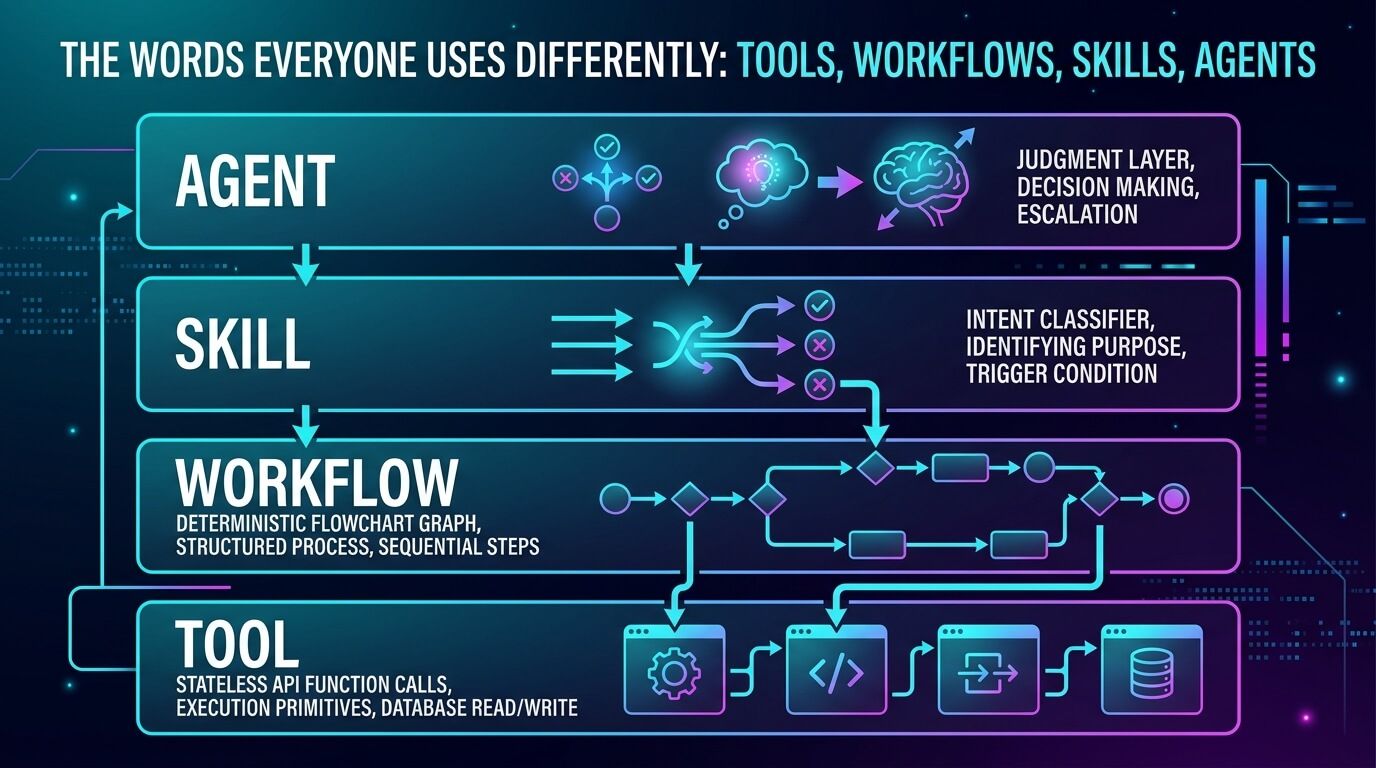
The four-layer map (and why each one exists)
Picture a call center. Not as a metaphor — as a literal architectural reference.
Layer 1: Tool — The screen the rep looks at
A new hire on day one. Someone shows them the order-lookup screen: type an order number, hit enter, see the status. That’s it. One screen, one action, no judgment required.
In AI terms: A stateless, single-purpose execution primitive. A function call. An API hit. A database read. Model Context Protocol and function-calling APIs across every major LLM vendor converge on roughly this definition.
flowchart LR Input["Order ID"] --> Tool["Order Lookup API"] Tool --> Output["Status: Shipped / Delayed / Cancelled"]Failure mode: The screen is down. The API times out. The response shape changes. This is a plain engineering bug — nothing about “AI” is involved in diagnosing it.
Test it like: Any external integration. Timeouts, malformed responses, rate limits, schema drift.
Layer 2: Workflow — The script the rep follows
By week two, the rep has a script for “customer wants to know where their order is”:
- Ask for the order number
- Look it up (the tool)
- Read the status back
- If delayed → offer discount code from approved list
- If cancelled → initiate refund flow
Follow the steps in order and you get a consistent outcome every time. The tool is now wrapped in a sequence of decisions.
In AI terms: A fixed, deterministic graph a human designed in advance. A flowchart you can draw on a whiteboard before any AI touches it. Every branch is a real edge you can trace — not an LLM improvising a new shape every run.
flowchart TD Start(["Call starts"]) --> Ask["Ask for order number"] Ask --> Lookup["Call order-lookup tool"] Lookup --> Check{"Status?"} Check -->|Shipped| ReadShipped["Read: 'Your order shipped on...'"] Check -->|Delayed| OfferDiscount["Offer discount code"] Check -->|Cancelled| Refund["Initiate refund workflow"] OfferDiscount --> End(["Call resolves"]) ReadShipped --> End Refund --> EndCritical distinction: Some platforms use “workflow” to mean an LLM improvising turn-by-turn with no predetermined shape. These are architecturally opposite things wearing the same label. One fails predictably along a graph you can inspect. The other fails unpredictably in ways only visible after the fact.
Failure mode: The sequence is wrong. The discount step fires before the delay is confirmed. A branch nobody anticipated (a partially shipped order) has no path at all. This is a logic bug, discoverable by tracing the graph — not by re-reading a prompt.
Test it like: A state machine. Does every branch have a destination? Is there a path for the case nobody expects? Can you simulate 100 conversations and verify each ends in a valid terminal state?
Layer 3: Skill — The rep who doesn’t need the script open anymore
By month two, the rep doesn’t need the script open. They’ve run it often enough that they handle the whole “where’s my order” call smoothly, unprompted, without a supervisor checking their screen. They recognize the intent (“where is my order”) and execute the right workflow automatically.
In AI terms: A workflow that’s been proven reliable enough to run without a human watching every execution. The workflow plus its trigger condition. Some vendors mean “a saved prompt template.” Others mean “a fine-tuned capability.” This post uses the operational definition: a workflow with a reliable classifier in front of it.
flowchart TD UserInput["Customer: 'Where's my order?'"] --> Classifier["Intent Classifier"] Classifier -->|where_is_order| Skill["Where-Is-My-Order Skill"] Classifier -->|other| Fallback["Other skill / escalate"] Skill --> Workflow["Deterministic workflow graph"] Workflow --> Tool["Order lookup tool"]Failure mode: The workflow itself is fine, but the trigger is unreliable. The rep runs the wrong script for the caller’s actual problem. Over-relies on habit when the caller says something the script never anticipated. This is a classification problem — not a tool problem, not a workflow problem.
Test it like: Classification accuracy. Given 100 different phrasings of the same request (including typos, slang, multi-intent utterances), does the right workflow actually fire? What’s the confusion matrix?
Layer 4: Agent — The rep who decides which script applies
The rep themselves — the person who decides which script applies when a call comes in, notices when a caller’s actual problem doesn’t match any script they’ve been given, and escalates instead of forcing it.
Tools, workflows, and skills are things an agent has. The agent is the one deciding when to reach for which one.
In AI terms: The judgment layer. Deciding which skill applies. When to improvise. When to refuse. When to escalate. This is the layer vendors gesture at with “the agent figures it out” — and it’s exactly the layer that’s genuinely hardest to test deterministically, because its whole job is handling the case that wasn’t anticipated.
flowchart TD Incoming["Incoming request"] --> Agent["Agent: Judgment Layer"] Agent -->|Known intent| SkillA["Skill A: Refund"] Agent -->|Known intent| SkillB["Skill B: Order status"] Agent -->|Known intent| SkillC["Skill C: Tech support"] Agent -->|Unknown / ambiguous| Clarify["Ask clarifying question"] Agent -->|Out of scope| Escalate["Escalate to human"] Agent -->|Multi-intent| Decompose["Decompose → route to multiple skills"]Failure mode: None of the above happens — the tools work, the workflows are sound, the skills classify correctly — but the overall judgment is still wrong. The rep correctly runs a perfect script for a caller who actually needed to be escalated to a human supervisor, because nobody built the “notice this doesn’t fit any script” layer at all.
Test it like: You can’t fully. This is the layer that requires eval sets, human review, and production monitoring. But you can test: does the agent refuse out-of-scope requests? Does it ask clarifying questions when ambiguous? Does it decompose multi-intent requests instead of picking one at random?
The sequence: what actually happens on a real request
Here’s the end-to-end flow, because the handoffs between layers are where production systems silently corrupt state:
sequenceDiagram    participant User    participant Agent as Agent (Judgment)    participant Router as Intent Router    participant Skill as Skill (Workflow + Trigger)    participant Workflow as Workflow Graph    participant Tool as Tool (API/DB)
    User->>Agent: "I need help with my order"    Agent->>Router: Classify intent    Router-->>Agent: Intent: "where_is_order" (confidence: 0.92)    Agent->>Skill: Invoke Where-Is-My-Order skill    Skill->>Workflow: Execute workflow graph    Workflow->>Tool: Call order-lookup API    Tool-->>Workflow: { status: "delayed", eta: "2026-08-28" }    Workflow->>Workflow: Branch: delayed → offer discount    Workflow-->>Skill: Result: discount offered    Skill-->>Agent: Skill completed    Agent-->>User: "Your order is delayed until Aug 28. I can offer a 15% discount..."
Notice the handoffs:
- Agent → Router: Judgment delegates classification
- Router → Skill: Classification triggers a proven workflow
- Skill → Workflow: Skill owns the workflow execution
- Workflow → Tool: Workflow orchestrates tool calls
- Tool → Workflow: Tool returns data, workflow decides next branch
- Workflow → Skill → Agent → User: Results bubble back up through each layer
Each arrow is a contract. Break the contract at any layer and the layers above get corrupted input.
Where the industry actually agrees (and where it doesn’t)
| Term | Consensus | Where it fractures |
|---|---|---|
| Tool | High — stateless function/API call | Almost none. MCP and function-calling APIs converged here. |
| Workflow | Low | “Fixed graph designed in advance” vs “LLM improvises each turn” — architecturally opposite. |
| Skill | Very low | “Prompt template” vs “fine-tuned model” vs “named workflow with a trigger” — same word, different failure modes. |
| Agent | None | “Chatbot with system prompt” ↔ “fully autonomous planner” — the disagreement is how much judgment is built vs assumed to emerge. |
The fastest tell when evaluating a platform: Ask which of these four layers is a distinct, inspectable thing versus which ones are just the same prompt described four different ways.
What this means if you’re actually building one
The practical version of the four-layer split: build and test each layer against its own failure mode, not against “does the whole thing feel smart in a demo.”
| Layer | Build against | Test against |
|---|---|---|
| Tool | External integration contract | Timeouts, malformed responses, rate limits, schema changes |
| Workflow | State machine completeness | Every branch has a destination; unexpected inputs have a path; graph is traceable |
| Skill | Classification reliability | 100+ phrasings → correct workflow fires; confusion matrix tracked; regression tests on classifier |
| Agent | Judgment boundaries | Refuses out-of-scope; asks clarifying questions; decomposes multi-intent; escalation rate monitored |
This is also, not coincidentally, close to how Wetel’s own workflow engine is shaped: a node-graph workflow is the fixed, inspectable middle layer — every branch is a real edge you can trace, not an LLM improvising a new shape every run — with tool-calling nodes underneath it and an intent-routing layer above deciding which workflow (which “skill”) a given conversation should run. The graph doesn’t remove the judgment layer; it just gives the judgment layer something concrete and debuggable to hand off to once it decides.
Where this actually breaks in practice
Three failure modes show up constantly once a layered system leaves the demo environment and meets real users and real requests.
1. The “tool call worked but workflow didn’t handle the response” bug
The order-lookup API returns { status: "partially_shipped", items: [...] } — a shape the workflow graph never anticipated because the API added a new status enum last sprint. The tool call succeeded (HTTP 200, valid JSON). The workflow has no branch for this value. The agent either crashes, hallucinates a response, or falls back to a generic “I’m having trouble” message.
Root cause: Tool schema evolution wasn’t coupled to workflow graph validation. The tool layer changed; the workflow layer wasn’t notified.
Fix: Contract testing between tool output schemas and workflow branch conditions. CI fails if a tool returns a value the workflow doesn’t handle.
2. The “skill classifier drifts but workflows stay perfect” bug
The “where is my order” skill fires on “where’s my stuff” (good) but also fires on “where’s my refund” (bad — different workflow). The classifier’s confidence is 0.87 on both. The refund workflow never runs. Users get order status when they wanted refund status. NPS drops. Nobody notices for weeks because the tool calls all succeed and the workflows all execute correctly.
Root cause: Skill = workflow + classifier. The workflow was tested. The classifier wasn’t regression-tested against a held-out eval set that includes near-miss utterances.
Fix: Skill-level eval sets. Not “does the workflow work” — “does the right workflow fire.” Track confusion matrices per skill. Alert on drift.
3. The “agent has all the skills but picks the wrong one” bug
User says: “I want to cancel my order and get a refund for the shipping delay last month.”
- Skill A: Cancel order (matches “cancel my order”)
- Skill B: Refund for delay (matches “refund for shipping delay”)
- Agent picks Skill A. Order cancelled. Refund never requested. User calls back angry.
The agent had both skills. The classifier could have detected multi-intent. But the judgment layer defaulted to “pick the highest-confidence single intent” because nobody built the decomposition logic.
Root cause: Agent judgment layer assumes single-intent requests. Multi-intent, conditional, and out-of-scope handling were never implemented — just hoped to emerge from a prompt.
Fix: Explicit decomposition logic in the agent layer. Multi-intent eval cases. Escalation paths for ambiguous requests. Monitor “re-contact within 24 hours” as a proxy for judgment failures.
What Wetel’s architecture does, honestly
Given how much of the above can be oversold, here’s a plain description of the actual mechanism.
Wetel’s architecture enforces the four-layer separation at the engine level, not just in documentation:
- Tools are external integrations with defined schemas, timeout policies, and retry logic. They know nothing about workflows.
- Workflows are deterministic node graphs (YAML/JSON) — every node, edge, and branch is inspectable, version-controlled, and testable in isolation. No LLM improvisation inside the graph.
- Skills are workflows + intent classifiers + eval sets. The classifier is a swappable component (regex, embedding-based, fine-tuned) with its own test harness. Skills are registered in a catalog with metadata: version, owner, eval results, last regression test.
- Agent is a thin judgment layer: intent routing → skill selection → multi-intent decomposition → escalation policy. It does not contain business logic. Business logic lives in workflows.
The honest caveat: This separation adds latency (extra hops) and complexity (more moving parts). A single-prompt “agent” is faster to demo. But the single-prompt agent is also the one that hallucinates a refund policy, calls the wrong API, and leaves no trace of why — because there are no layers to inspect.
The four-layer architecture makes the easy things easy to debug (tool timeout? workflow branch missing? classifier confusion?) so the hard thing (judgment) gets the attention it actually needs.
Why most vendors don’t actually separate these layers
None of the four layers is exotic in isolation. Tools are API calls. Workflows are state machines. Classifiers are classifiers. Judgment layers are prompts with guardrails.
What makes the separation rare in practice is that all four have to work together, with clean contracts between them, without any one layer silently assuming the others already handled the coordination.
It’s also the kind of architecture that’s easy to fake for a demo and expensive to get right for production. A scripted demo can hardcode the happy path — a clean request, a known intent, a perfect workflow execution. Making that hold up against a user who says “cancel that, actually refund me for last month, and by the way my email changed” means solving the classifier drift problem, the multi-intent decomposition problem, and the workflow extensibility problem for real, not just for the one scenario in the sales deck.
How to actually test this when evaluating a platform
Ask whoever’s selling you an “agent platform” to show you the layer boundaries in their system, live:
- “Show me a workflow graph.” Not a prompt. A graph — nodes, edges, branches. Can you trace a specific conversation through it?
- “Show me the tool schema and the workflow branch that handles each response value.” Is there a test that fails when the API adds a new enum?
- “Show me the skill classifier’s confusion matrix.” Not accuracy — the matrix. What does it confuse with what?
- “Show me the agent’s multi-intent decomposition logic.” Not “the LLM handles it.” The code.
- “Let me inject a tool failure mid-workflow.” Does the workflow have a compensation path? Does the skill surface the right error? Does the agent escalate or retry?
The gap between “has tools, workflows, skills, and agents” and “actually built four separable layers with contracts between them” is invisible on a spec sheet and obvious within the first thirty minutes of actually pushing on it.
This post reflects Wetel’s architecture as of August 2026. The layer definitions are operational — they describe how we build, test, and debug, not how we market. If your platform defines these terms differently, that’s fine — just know which layer you’re debugging when something breaks.